

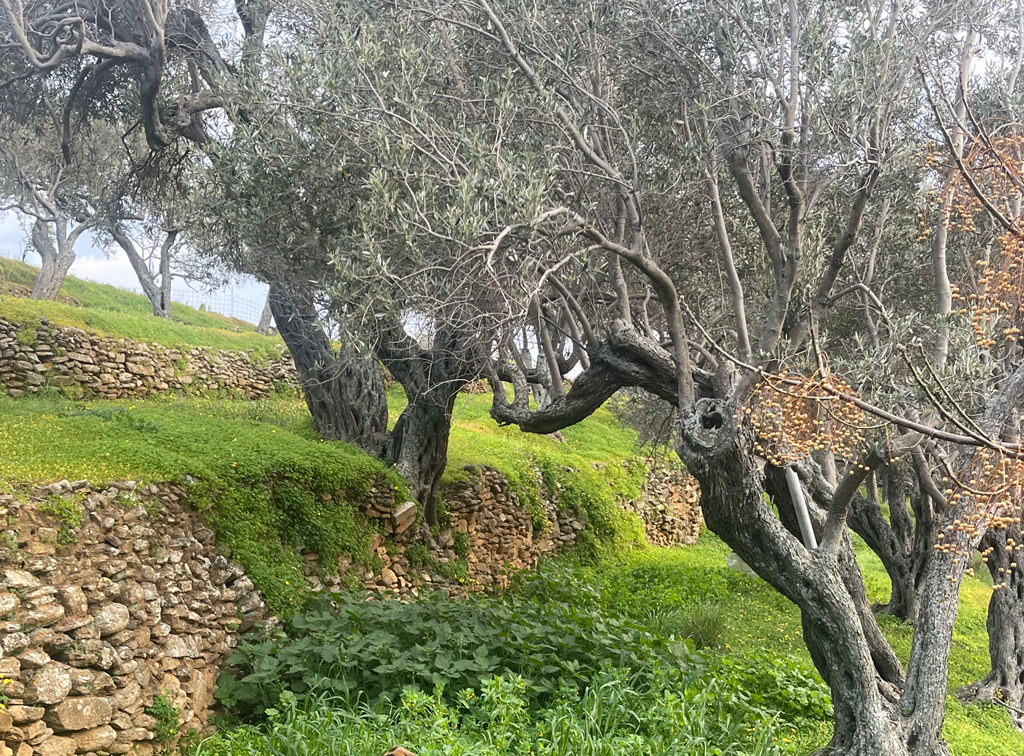
Address Agia Triada, Tinos
Space Type Parcel of land
Location Chora
Period 20th Century
The field owned by Dimitris Gryparis is in the location of Agia Triada near Chora of Tinos and has easy access by road. It is about 10 acres and most of it is terraces with olives and vines while a small part includes fruit trees. It includes animal shelters, two wells, a large water storage tank and power for his pumping machine. The needs for tools for agricultural work were many, such as harrows, chisels, rakes, hoes, etc. Despite the location of the field, many of the tools that Mr. Gryparis needed were taken from the blacksmith shop of Kostas Alexopoulos in Pyrgos.
Tools


Some agricultural tools from the Museum of tools Marlas photography by Alexandra Grypari
The tools used by farmers in Tinos did not differ from other regions of Greece and were mostly made of wood with iron parts. The quality and technique with which the metal parts of these tools were made played a very large role in facilitating agricultural production, since in the previous centuries people usually, in addition to being professional farmers, often produced what they consumed themselves . A typical series of agricultural tools was the plow with the wool, the rake, the hoe, the spade, the scythe, the chisel, horseshoes if the farmers had horses, etc. Other very useful objects for the farmers and possibly all the inhabitants were doors, locks, picks, etc.
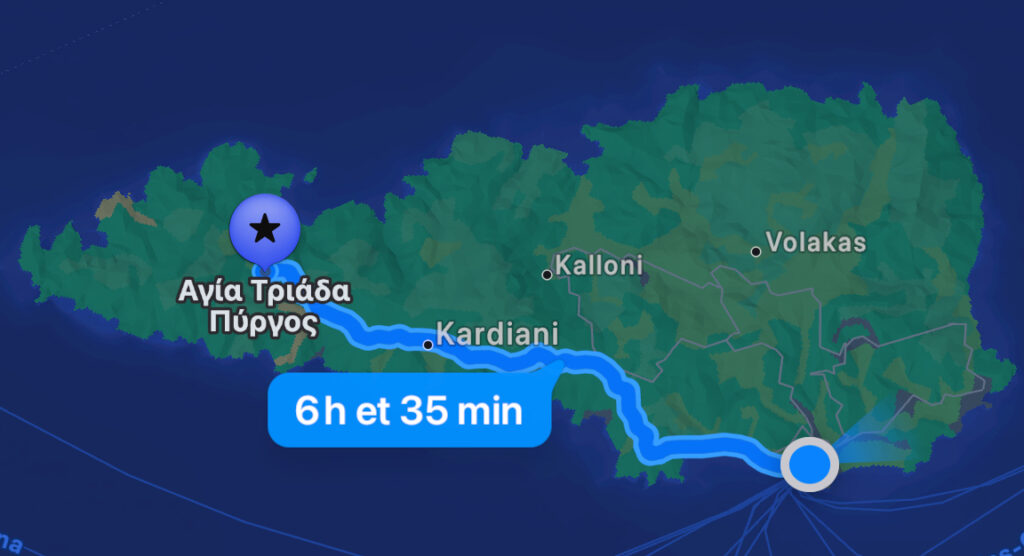
Chora – Pyrgos proposed duration of journey in contemporary times
To procure or repair some of these glories the peasants usually went to a blacksmith’s shop near their house or field. In some cases, however, such as that of Dimitris Gryparis, if there was a craftsman known for his skill in his art despite his great distance from the field or the house, he was ultimately preferred. So Dimitris Gryparis preferred Costas Alexopoulos for his donkey and made a trip of about 30 kilometers from Chora to Pyrgos with his donkey.
Field
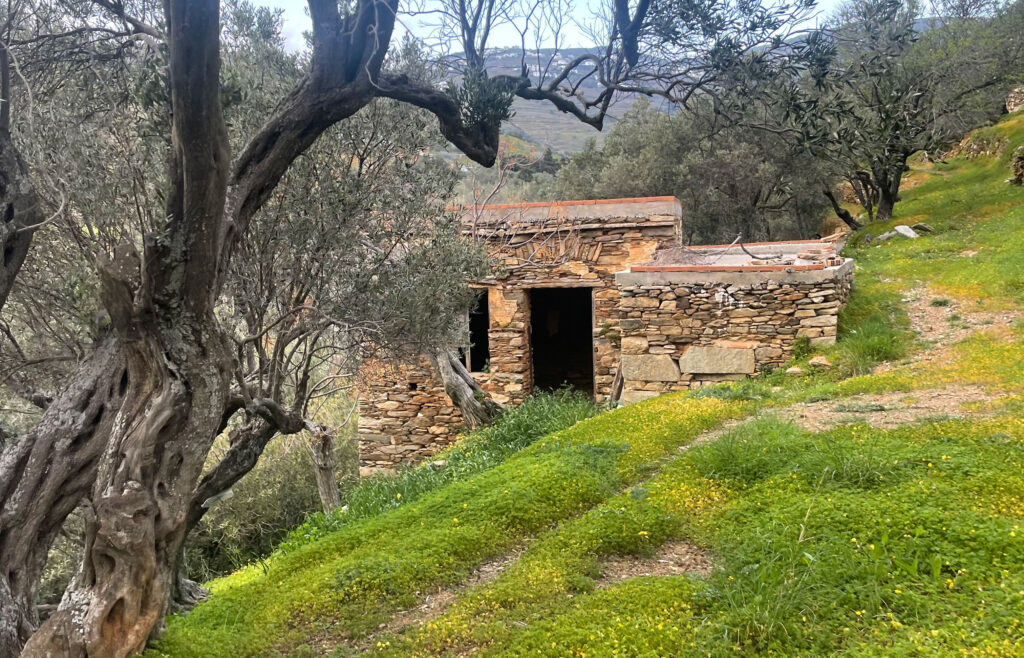
Field owned by D. Grypari Photos NOMO NPO
It is accessible from all sides as it is surrounded by paths and a road has come on one side. This helps a lot in sowing because it can be done with a tractor and not with animals. It contains two wells and a cistern for storing water. One of its auxiliary spaces is a building, the size of large animals with a manger for straw and a trough for food. Threshing and seed cleaning and storage area. The owner of D. Gryparis calls it “the field of Krikelis”, after its previous owner. When Dimitris took the decision to become a farmer in addition to the rest of the fields that belonged to the family, he worked for many years on the ships in order to be able to buy a field of such size and wealth that he had as his daughter Alexandra tells us
It included everything, especially water, which was the biggest difficulty to carry from a distance, on foot or with animals depending on the conditions of the area.
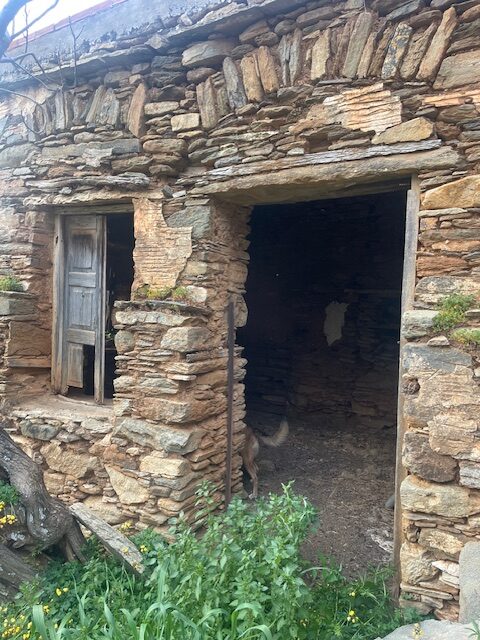
Field owned by D. Grypari Photos NOMO NPO
It contains many olive trees, vines and a garden with citrus trees and summer fruits. In autumn a large part of the field is threshed and sown with barley for the animals. Furrows are made for winter potatoes and tomatoes, but also in the spring, okra, string beans, watermelons and melons etc. are planted. It has a large production because it has water all year round from its two wells but also from the cistern that brings the water to its other side and thus has water throughout the length and width of the field. It usually accommodates large animals, as there are facilities for such a thing, but also smaller ones. In the past, there were sheep and goats in the field during the empty seasons, but also cows three or four times, in the dam which is almost an independent space. It has a threshing floor to sort out the seeds and save them for next year. It is an isolated production unit for the insular form of the farmer who is part cultivator, part producer and part breeder, who produces everything he needs and in the best of cases can also secure a small income from the surplus of the grain.
Tinos
Tinos is that island of the Cyclades whose geographical position and historical circumstances contributed to play a special role in the wider region mainly in the 16-18 century. Subject from 495 AD to the Byzantine “subject of the seas” like the other islands of the Aegean, Tinos changes after the conquest of Constantinople by the Crusaders.
In Tinos during the years of the Venetian rule, an “idiosyncratic Tinian feudalism” prevailed. The population from the 15th – 20th centuries was distributed throughout the island and in a large number of villages. The population was divided into two categories, one was the landowning class consisting of the 69 timarius and cittadini who did not belong to noble families, and on the other the landless contadini – the class of local peasants who did all the chores and the taxes. The landless peasants owned these fields and cultivated them for their own needs paying tax, the tithe, to the landowners. These timaras were passed down from generation to generation without being able to be sold or given away if there was no descendant.
Bibliography
The research is based on data found among others in the books of Florakis A., 2013, “The “gyftika” of Oxo Meria Tinos forges and smithies in the 19th and 20th centuries”, Athens: Fraternity of Tinians in Athens, Karali M., 2002, ” The rural dwellings in Exomeria of Tinos”, Athens: Cultural technological foundation of тне Hellenic bank of industrial development, Moschatos A., 2000, About the Island of Tinos (1855), Athens: Society of Tinian Studies, Collective volume, 1979, Ethnography, Athens: Peloponnesian Folklore Foundation, Florakis A., 2018, “Old quarries and marble splitters of Tinos” Athens: Piraeus Bank Group Cultural Foundation (PIOP), Collective volume, 2009 “Tetradia Exomerias” Athens: edited by Kostas Danousis, Collective volume, 2009 “Memoirs of Panormos” Athens: edited by Kostas Danousis, Collective volume, 2024 “Navigare necesse est honor to Kostas Danousis”, Athens: Fraternity of Tinians in Athens, in exhortations and directions of Dr Florakis and Mr Danousis, in other essays such as those of Iakovos Rigos but also in interviews conducted by the NWMW team in the context of the Fe26 project – “Sculpting memory”.
More info on the traces project here