

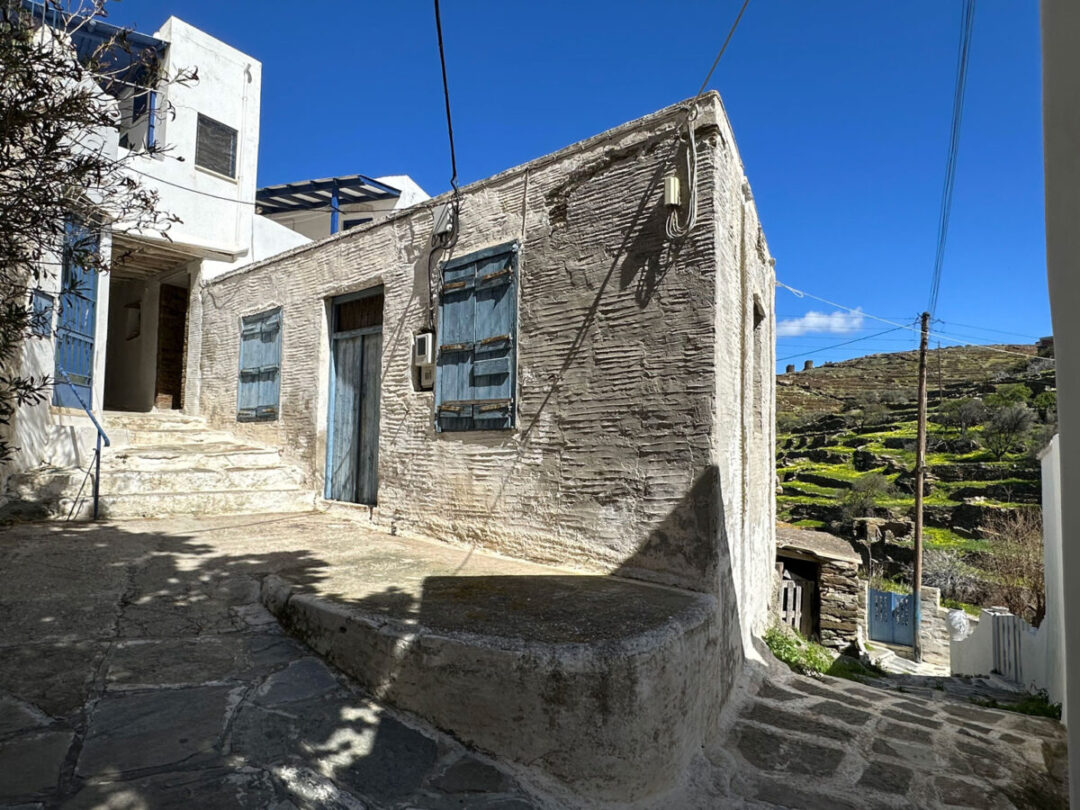
Address Isternia, Tinos
Space type Pre – industrial space
Area Exo Meria
Time period 1870 – 1880, 19th century
The third forge of the Rigos family, later the forge of Yiannis & Kostas Alexopoulos, is located in the Pyrgos village of Tinos, the largest stone carving center of the island and was built around 1905 by Iakovos (Giakoumis) Rigos. The workshop, located next to Agios Dimitrios, is a gamma-shaped one-room building, originally built for a blacksmith shop, with a storage basement and surrounding auxiliary space on the back side of the blacksmith shop. From the front side it has easy access to the street. Yiannis Alexopoulos & his son Kostas collaborated and served needs in new tools, all kinds of repairs and general quarrying, marble and sculpture tools. When quarries and other needs decreased, the manufacture of mandrakas for all of Greece increased.
History of the smithy
The smithy pictured above is located in the village of Pyrgos in Tinos, which was the largest stone mason and marble crafting center of the island. The smithy was built around 1905 by Iakovos (Giakoumis) Rigos. It then became the workshop of the master technician Yiannis Alexopoulos and later of his son Kostas Alexopoulos, who specialized in the creation of quarry and marble tools. Its current form was reconstructed by Yiannis Alexopoulos around 1920. The workshop was very good at creating tempering tools. Tempering is the method of hardening the tool which is immersed once forged in water or oil. It was such a good smithy for tempering that they were sent tools and mandrakas to temper from other parts of the island. They didn’t share their tempering technique with other blacksmiths so that they wouldn’t lose any clients. Although the history of the family does not have many members, it is interesting because it had very important tool equipment and mainly because they produced an original type of mandrakas that the craftsman’s father himself had developed in collaboration with his son. “barba“ Yiannis (barba is used in greek to signify a master technician) and his son, barba Kostas Alexopoulos, became two famous blacksmiths, who together with Dimitris Hatzis covered the need for marble tools for 150 years. Their workshop became a center of mandraka production for Tinos and the rest of Greece also internationally used in workshops and for restorations or marble works.
History of the Rigos – Alexopoulos family
The third son of Yiannis Rigos, Iakovos-Giakoumis, after he worked in his father’s shop in Ysternia and in the quarry in Khousla, opened his own smithy in Pyrgos, where there was a high demand for tools due to the large number of quarries and marble in Panormos. At that time, only one blacksmith shop operated in Pyrgos, that of Antonis Sofianou, the brother of the marble sculptor Dimitris Sofianou. In Pyrgos, in addition to the marble tools, he undertook all other blacksmith work. Yannis Alexopoulos also worked with him. Iron gates created by Iakovos Rigos used in the churches of the village are preserved at Agios Nikolaos, Agios Dimitrios and Sotira. In 1911, Iakovos Rigos expanded his field of activity by opening a shop first in Piraeus and then in Athens, near Omonia.
The Astir newspaper of Tinos announces the event:
“Our well-known fellow citizens Mr. Iakovos Rigos and Venardos Saltamanikas renovated a perfect smithy in Piraeus and despite the old vegetable market near the bridge. (…) Our fellow stonemasons will be very pleased, as they know very well that only our fellow citizens make the best tools of their art (…).”
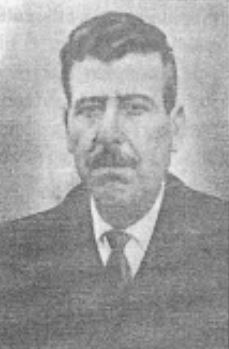
Yiannis Alexopoulos. © Alekos Florakis
Ioannis Alexopoulos did not come from a family of blacksmiths. While still a child, he was sent to work in the green marble quarries in the northern part of Exo Meria, in Khousla, at the wire cutting machine (a machine for cutting large volumes of green marble). Through an Italian engineer he went to work in the machine shop of John McDowall and Barbour in Piraeus for several years. In Piraeus he came into contact with the art of blacksmithing, he learned it, to continue later for a year and a half with Markos Rigos (Hiannis’ son) in Athens where he was introduced to the manufacture of marble tools. After his military service, he returned to Pyrgos Tinos, he worked for a while with Iakovos-Giakoumis Rigos who was famous for his batons, making marble tools until he bought the latter’s workshop.
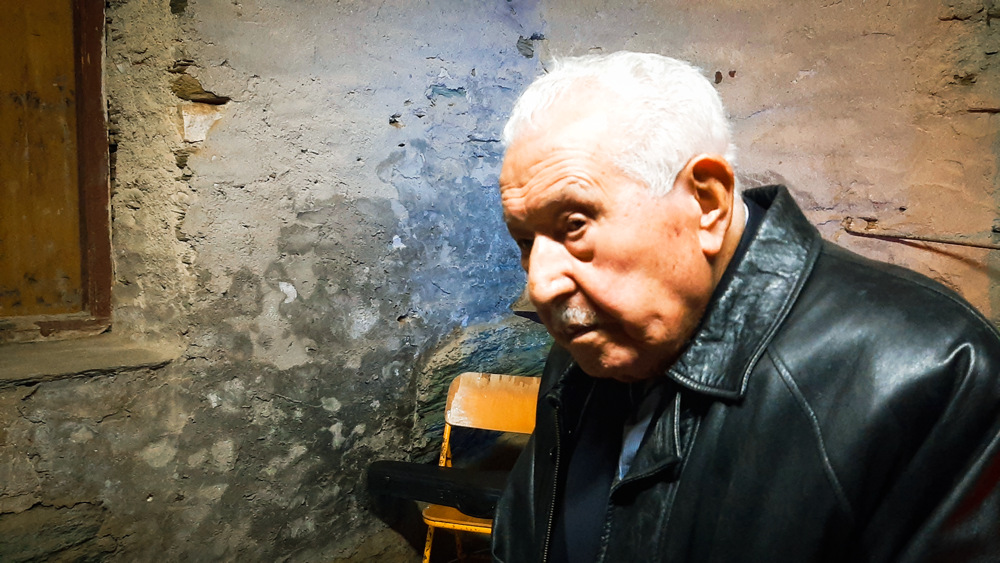
Kostas Alexopoulos in his smithie. © Alexandra Gryparis
Kostas Alexopoulos
The son of barba Yiannis Alexopoulos, barba Kostas did not want to become a blacksmith, based on his own words, he had a talent for drawing and wanted to be a marble worker, but his father put him in the blacksmith shop. Because, among other things, the large need for unpaid staff in the blacksmith shop due to the region’s need for tools. Barba Kostas took design lessons before the war and after his military service he went to the workshop where he spent difficult years with his very strict and taciturn father. The other craftsmen who went to the workshop, marble workers, tilers, farmers, etc, told the father that the young man was skilled and the father did not want his son to hear this praise. However, he became one of the best craftsmen, greatly increased the clientele and kept the blacksmith shop after his father’s death until 2003, when Dimitris Hatzis, his brother-in-law, took over.
Dimitris Hatzis, the last blacksmith of Pyrgos, started in 1996 as Barba Kostas’ apprentice where he learned the art of blacksmithing. In 2003 Barba Kostas retired and closed the workshop and Dimitris opened his own workshop, in the old marble shop of Lazarus and Nikolaos Valaka, just outside the village keeping the name and the clientele. Over the years the need changed a lot and so did the orders. Ready-made tools where now everywhere and very cheap, so people preferred them. Dimitris now creates tools for those who have more money and prefer handmade tools.
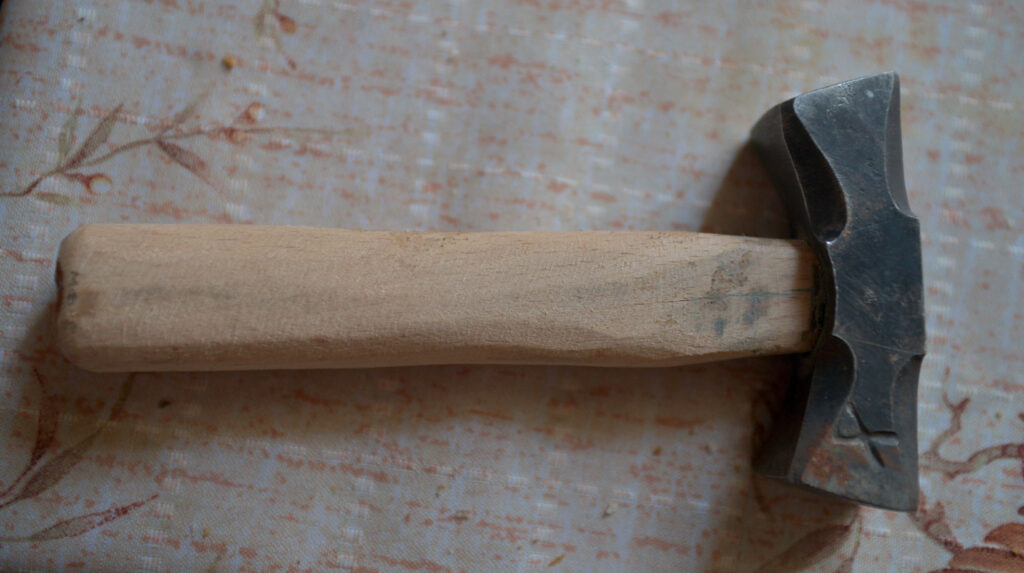
madrakas – marble craftsmen hammer by Kostas Alexopoulos. © Alexandra Gryparis
Around 1950 father and son patented a new mandraka with an altered shape, barba Yiannis probably saw it from German craftsmen. These mandrakas have a difference in shape that makes them easier to use and more flexible. The new shape enables crafters and users to work more comfortably and deliver more consistent hits. Ever since the patent was granted, things have opened up a lot according to barba Kostas. So much so that they hired an assistant from Platia. High demand led to hiring an assistant rather than turning down orders. The helper worked in the furnace with barba Yiannis and barba Kostas filed them and perfected them so that his father would finally paint them. They introduced into the market this new type mandraka and supplied all of Greece including the workshops of Athens, other cities, the archaeological restoration sites of Acropolis, Olympia, Epidaurus, Samothraki, quarries of many areas including Pendeli, Dionysus, Kozani, Kavala, Mytilene , Chios, Samos, Vytina, Rhodes etc. and even abroad. They wanted these tools in Athens in Dionysos, in Penteli, so many mandrakas they couldn’t supply all the demand.
Clientele
According to barba Kostas, the competition was good for the blacksmith business. While in other villages, let’s say in Ysternia, they gave the needles 2 drachma (equivalent to 1.5 cents) and barba Kostas in Pyrgos bought them for 5 drachma (about 4 cents). In this case the high cost did not work negatively for the craftsman because he did created quality tools. In order to create a good tool it is a function of the quality of the raw material and the know-how shown in (1) the boiling, if it boils too much it burns (2) the amount of atassal that goes into the steelwork (3) the paint (4) the final coating in the ironing (5) the inclination of the tool.
Form of smithy – equipment
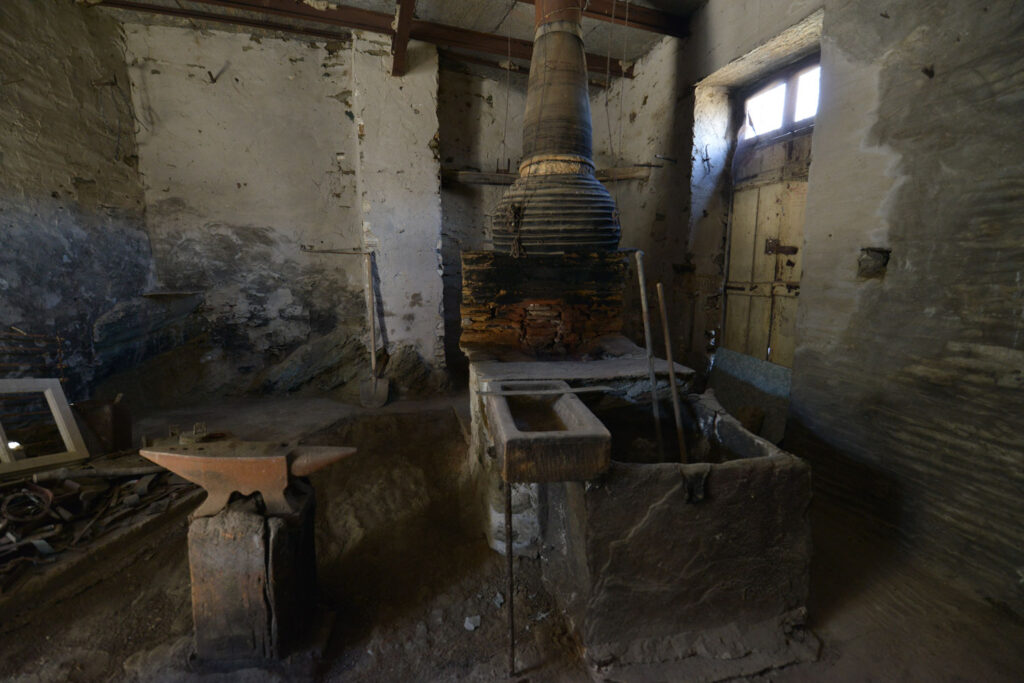
The interior of Kostas Alexopoulos smithy in 2022. © Alexandra Grypari
It is a common blacksmith, with a craftsman and an assistant permanently or occasionally, that could be found in most small centers with a small customer area claimed by other craftsmen. Its equipment included a furnace, bellows, anvils and chutes. The tools used were holding tweezers, heavy striking hammers, drilling, supporting, shearing, drawing, measuring, files for grinding, molds and curves for shaping.
The process for making tools using the forging technique are as follows: forging, steel plating, tempering. Forging is the mechanical processing of iron – while hot – with a hammer. The metal is placed on the anvil and repeated impacts creates gradual deformations. Hardening is the strengthening of the iron end of the tool by adding steel so that the two pieces of dissimilar metal form a whole. Tempering is finally the heat treatment where the steel is heated to a certain temperature and then immersed in water where it is rapidly cooled to harden.
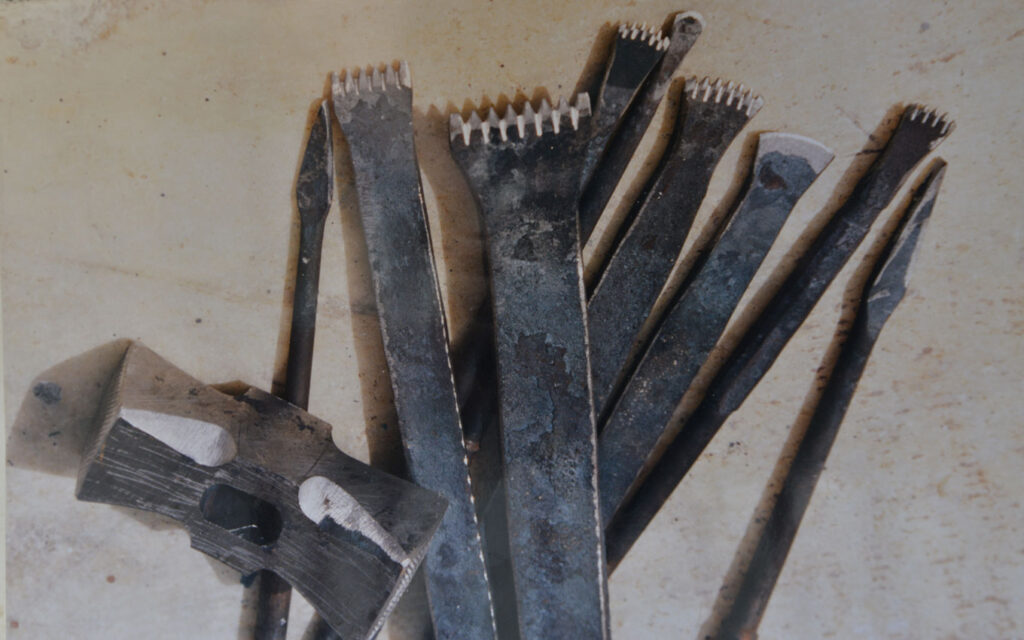
Tools created by Kostas Alexopoulos. © Alexandra Gryparis
Pyrgos
The central square of Pyrgos has all the elements of a fully equipped social space. It could be considered a theater stage in which the life of the village unfolds both on weekdays, holidays and festivals when it turns into a huge dance hall. In its structure, it is amazingly reminiscent of the village squares of Pelion. It is worth noting that very close to the square we find the community facilities for washing clothes, which were in use during the Second World War, one of the two parish churches, Agios Nikolaos, as well as the cemetery of Pyrgos, which is located a few meters away. It is unique to be included in the settlement and contributes richness and beauty of its tombstones and tombs. So from the moment that settlement existed, almost all the villagers went down on Sundays, during the holidays and on cold days of winter, for supplies, to sell their products, mainly cheese, to buy the necessities for survival, attended church, they saw acquaintances and friends and returned again to their rural houses. The distance to the square was not far they traveled there on foot or mostly by donkey or mule, on which they loaded their products.
Bibliography
The research is based on data found among others in the books of Florakis A., 2013, “The “gyftika” of Oxo Meria Tinos forges and smithies in the 19th and 20th centuries”, Athens: Fraternity of Tinians in Athens, Karali M., 2002, ” The rural dwellings in Exomeria of Tinos”, Athens: Cultural technological foundation of тне Hellenic bank of industrial development, Collective volume, 1979, Ethnography, Athens: Peloponnesian Folklore Foundation, Florakis A., 2018, “Old quarries and marble splitters of Tinos” Athens: Piraeus Bank Group Cultural Foundation (PIOP), Collective volume, 2009 “Tetradia Exomerias” Athens: edited by Kostas Danousis, Collective volume, 2009 “Memoirs of Panormos” Athens: edited by Kostas Danousis, Collective volume, 2024 “Navigare necesse est honor to Kostas Danousis”, Athens: Fraternity of Tinians in Athens, in exhortations and directions of Dr Florakis and Mr Danousis, in other essays such as those of Iakovos Rigos but also in interviews conducted by the NWMW team in the context of the Fe26 project – “Sculpting memory”.
More info on the traces project here