

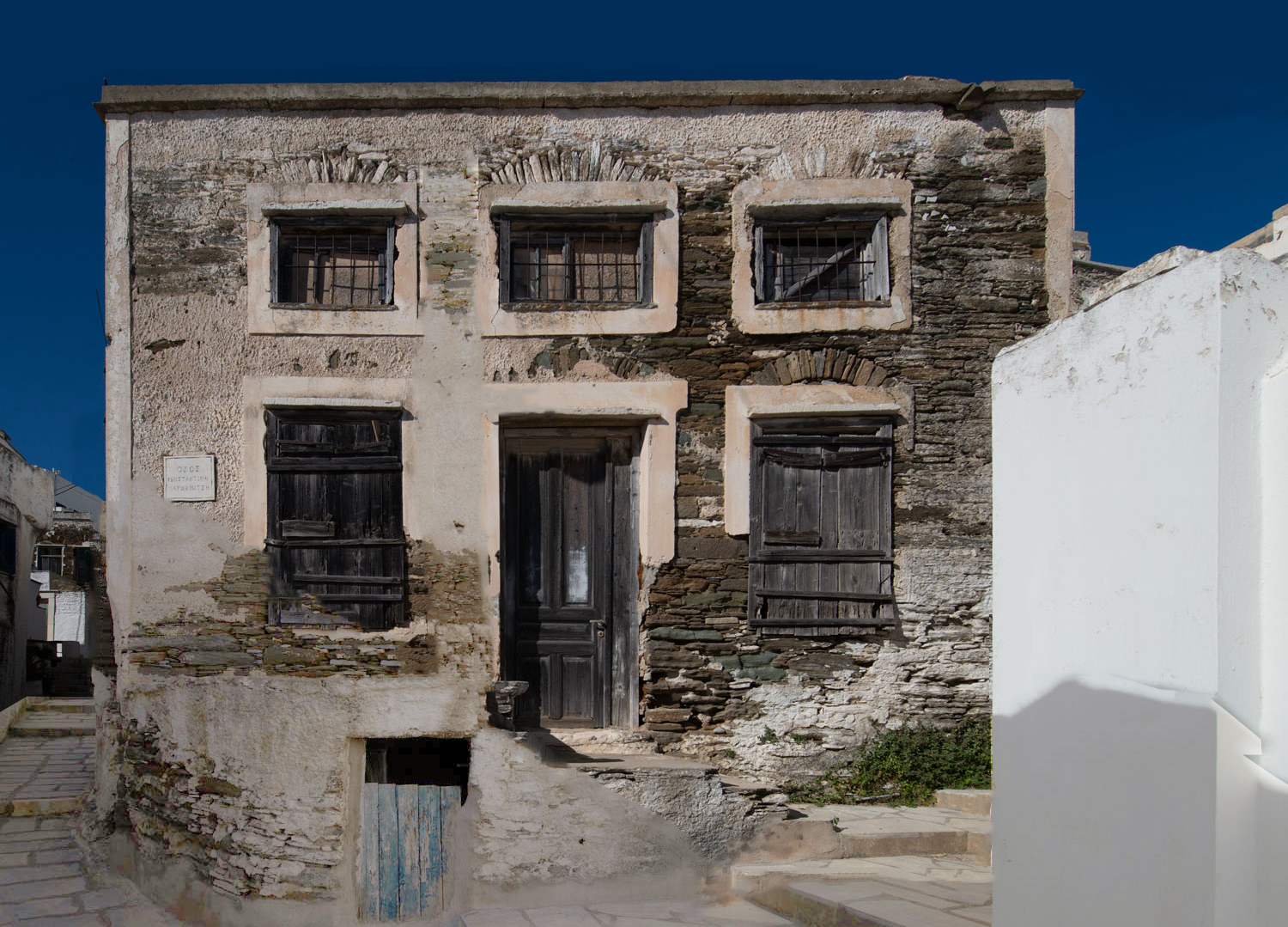
Address Isternia, Tinos
Space type Pre – industrial space
Area Exo Meria
Time period 1870 – 1880, 19th century
The forge of Yiannis Rigos -Hianis (other word for blacksmith)- was located in the village of Ysternia in Tinos, it was probably the first workshop of the family and was built, something rare for the time, to function as a pre-industrial space from the beginning – with a grinding mill and a blacksmith shop, a mill was added later. The exact date of its construction, has not been established. It is a large building. It includes a large central area and ancillary areas around the perimeter. At the front it includes large windows that allowed light to enter the space. The workshop was famous for the making of agricultural tools but in it many objects were made like quarrying and marble craftsmen’s tools, utilitarian and decorative objects on top of anything needed.
blacksmithing
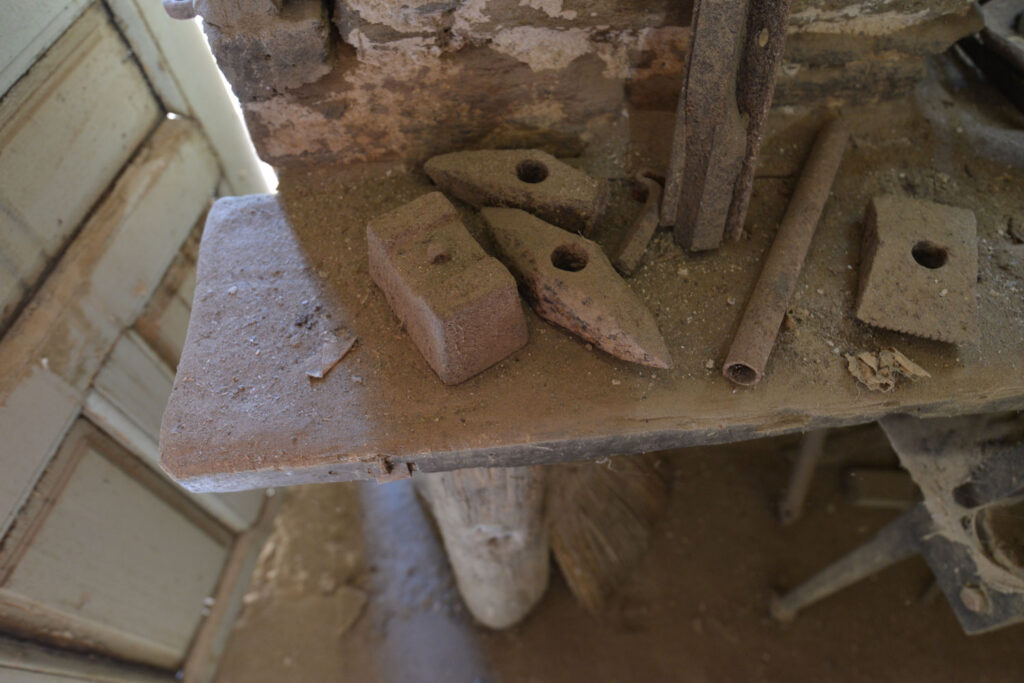
Agricultural tools from inside the smithy in Ysternia. © Alexandra Gryparis
Blacksmithing has rightly been called, “Mother of all arts”, because the other craft activities can not be done without tools made in a blacksmith. Therefore the blacksmith was indispensable in any human community, in all times and in all countries. The specialization of products produced by blacksmiths is linked to the economic activity of each place and in Tinos it covered the needs of stonemasons, quarries, farmers, basket weavers and also nautical parts of boats because in Exo Meria there were many sailors and captains. One of the blacksmith families of Exo Meria, originating from the village of Ysternia, which spans many generations, is the Rigos family
History of the Rigos family
The Rigos family from Ysternia has specialized in blacksmithing for five successive generations. From the beginning the building was built to function as a pre-industrial site – an oil mill with a blacksmith shop inside. We do not know the exact date of its construction, it is assumed that it was built around 1890. In the village of Ysternia, there were certainly two ironworks of the same family, the one pictured, which is probably the first, and another one belonging to Athanasius Rigos. The blacksmiths of the family in question greatly expanded their activity, opening forges in other villages of the island (Pyrgo, Xinara, Karkados) and in Athens. We will analyze the course of the family, with its progenitor Yiannis Rigos (or Hiannis) and some of his descendants who reach to present day, seven generations later, they are still blacksmiths.
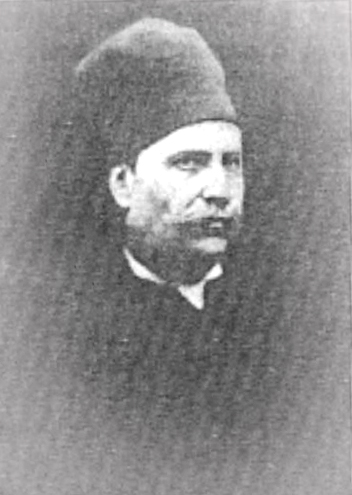 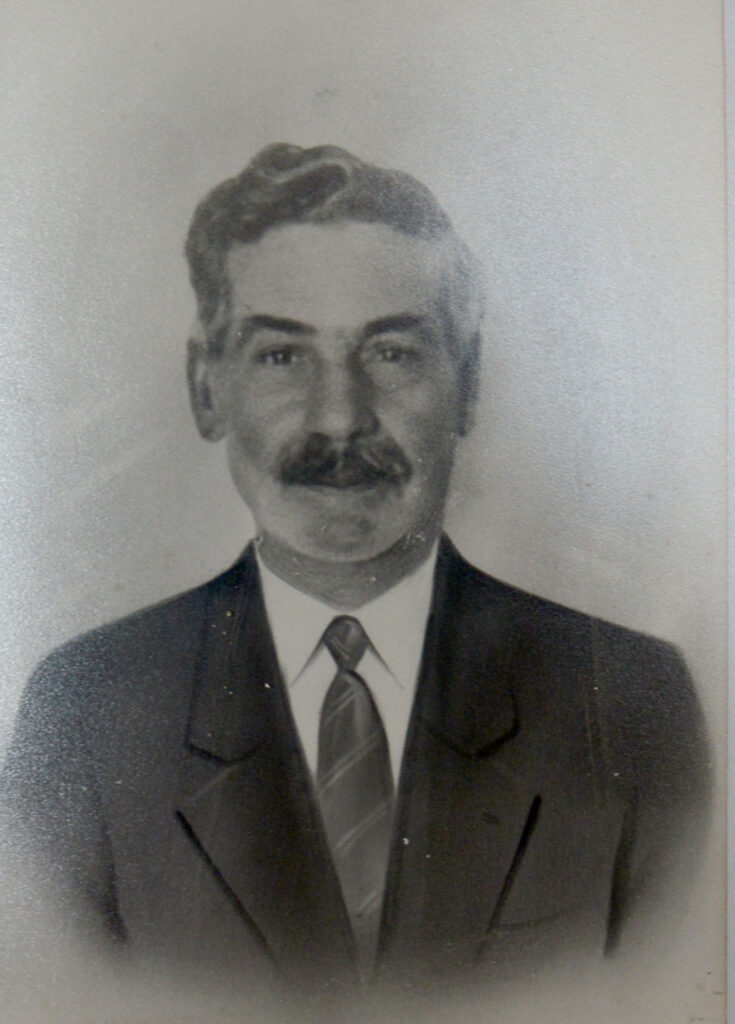 |
On the left we see Yannis Rigos and on the right the descendant Lefteris Rigos. The photos comes from the book “Gyftika of Oxomeria of Tinos”
Ioannis Rigos or Hyannis (1839 – 1910 or 1842-1912) learned the art of blacksmithing from his father and perfected it in Syros where he worked at a young age. Returning to Ysternia, he opened a smithy. His brother was the sculptor Iakovos Markou Rigos. He married and had nine children, three boys and six girls and his three boys became blacksmiths, Thanasis and Markos born in 1867, and Iakovos-Giakoumis born in 1873.
Thanasis was sent to Xinara by his father when he opened a blacksmith shop there predominately crafting agricultural tools. After working for several years in Asia Minor with his uncle as a blacksmith, Markos first opened a blacksmith shop in Athens and then worked for a time in Khousla, in the green marble quarry. Iakovos opened a smithy in Pyrgos around 1905. After the death of the progenitor barba Giannis (barba is used in greek to signify a master technician), the blacksmith shops of Xinara and Ysternia passed to his son Thanasis. Initially, the children cast lots among themselves and the shops fell to Iakovos but since he already had the workshop of Pyrgos and Thanasis wanted the forges of Xinara and Ysternia and so Thanasis kept them. Thanasis, following his father’s organization, continued to manufacture mandrakas (marble craftsmen hammer) in Ysternia and agricultural tools in Xynara.
Thanasis had seventeen children and three of his sons became blacksmiths. His son Markos took over Xinara, Nikolaos opened a new blacksmith shop in Karkados and Lefteris kept the Ysterni smithy. Lefteris was the last one to operate the smithy of the icon. The course of the family is followed by the genealogical tree listed below.
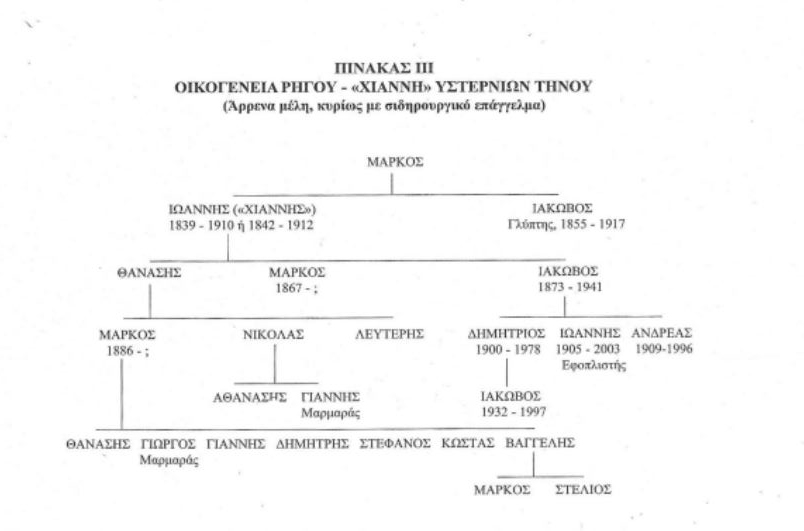
Genealogical tree of the Rigos family created by Alekos Florakis solely in Greek in his book “Ta giftika tis Oxomeria Tinos” © Alekos Florakis
Smithy
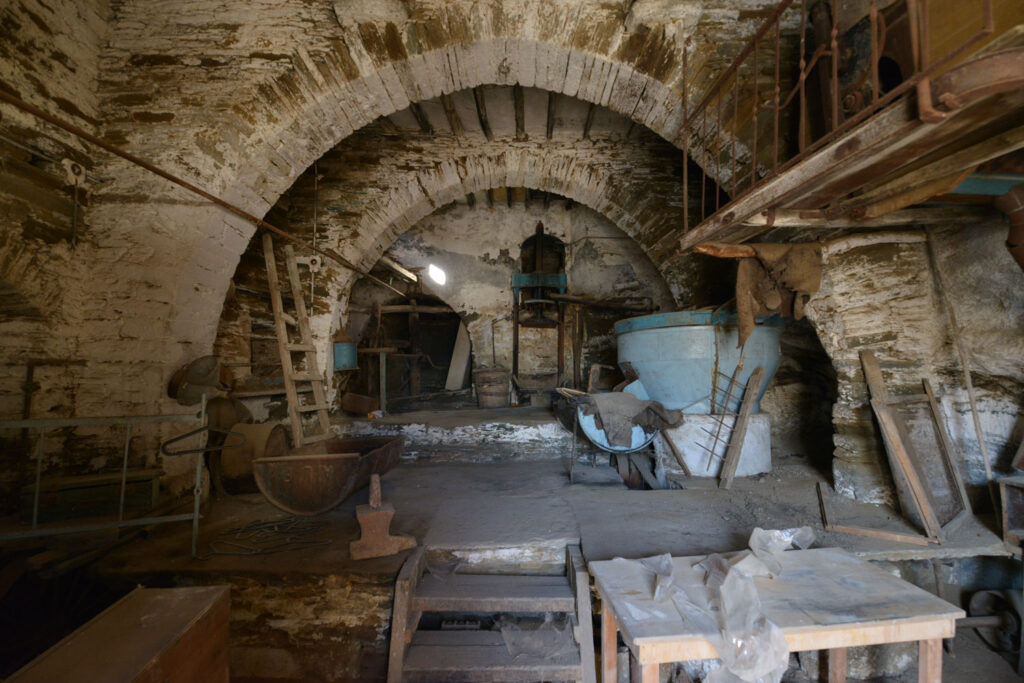
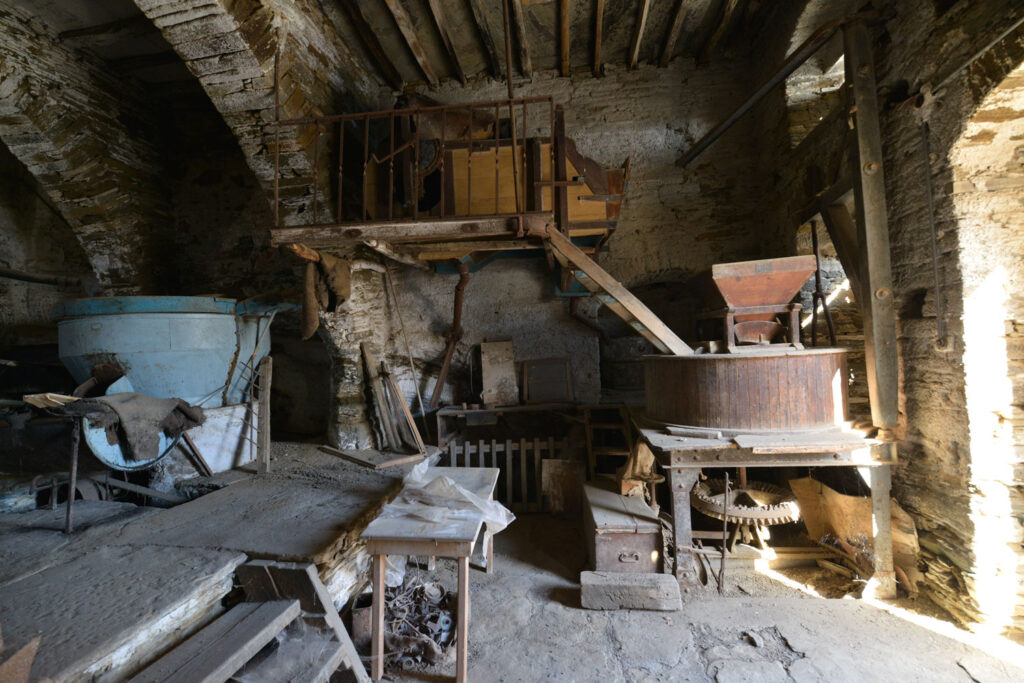
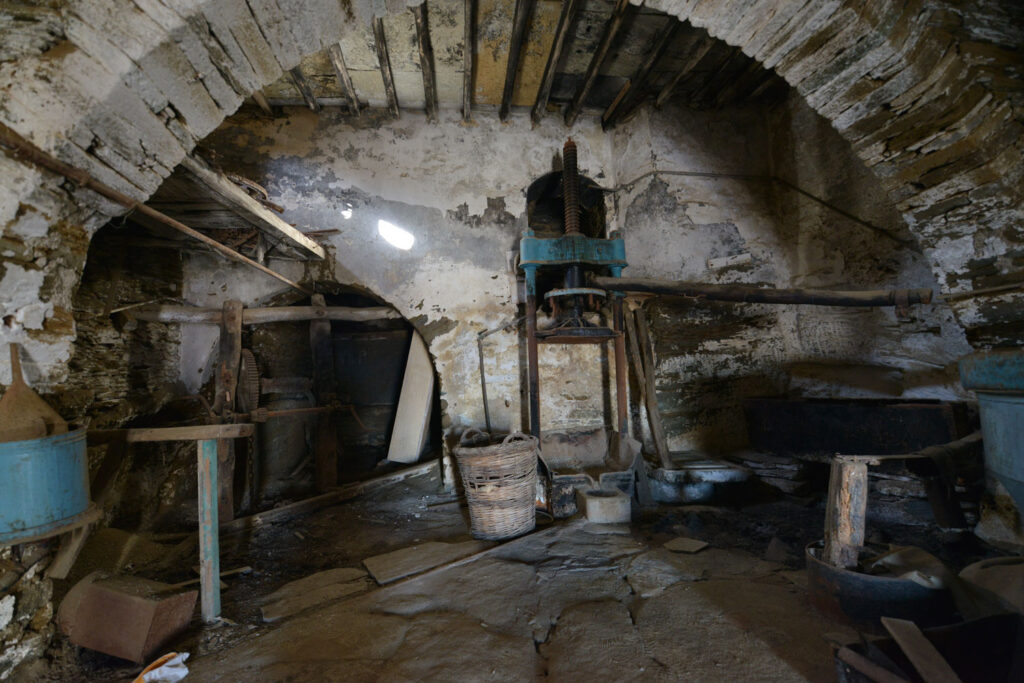
We see the interior of the smithy in Ysternia left as it was last used.. © Alexandra Gryparis
The smithy as we see it in the pictures above belonged to the grandson of barba Giannis, Lefteris Athanasios Rigos and operated until around 1970. Next to the smithy was originally included a small olive press and a mill was added later.
Comparative advantage
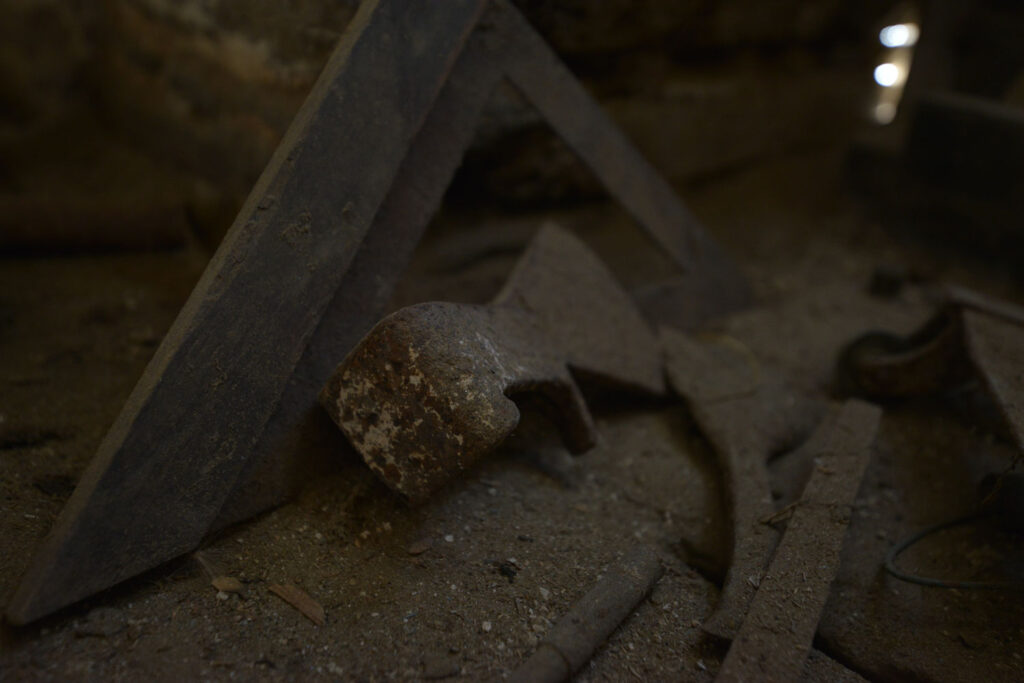
We see tools left in the Ysternia Rigos family smithy. © Alexandra Gryparis
Both barba Yannis and his son Markos were famous for their patents. Folk stories about barba Yannis:
“He also had a mill along with the smithy. Well he was not happy with the pressure on the towels, which they put in the olive pulp. And they thought that if he found a stronger screw, he would extract the pulp from the olive. So he went to Syra, brought a shaft from a ship and began to wrap it in a screw with a blade, that is, he made an external screwing. “…” Imagine a screw made by hand. He had his friend rub it with emery for a month, he rubbed it, rubbed it, wherever he found resistance and finally succeeded and thus improved his production.”
Clientele
Clients from Mesa Meri but also all over Tinos, Orthodox and Catholic, used to go to the workshop in Ysternia because in other parts of the island, steel plating (sticking to the iron steel) and painting (hardening by steep immersion in water) were not successful.
Ysternia
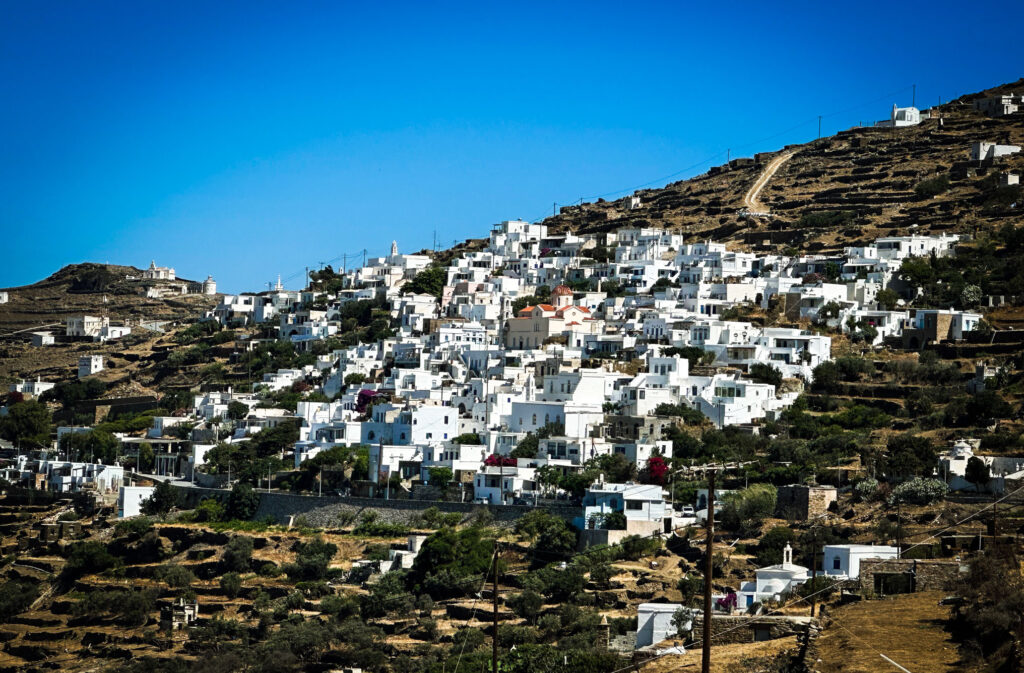
Ysternia village view from the road. © Alexandra Gryparis
Ysternia is located in Exo Meria, on the slope of the “Meroviglia” mountain. In Exo Meria, in the post-Kapodistrian years, three schools were founded, one of which was Greek in Ysternia. In 1885 it had 954 inhabitants. It was a village of sailors, artists and the birthplace of leading Tinian sculptors such as the Malakate brothers, Lazaros Sochos, Lazaros Lameras, Antonis Sochos, Georgios Vitalis, the Phytali brothers, etc. It is a village with impressive examples of marble work such as the Glyni marble square but also the churches of Agia Paraskevi, Agia Triada and Agia Anna.
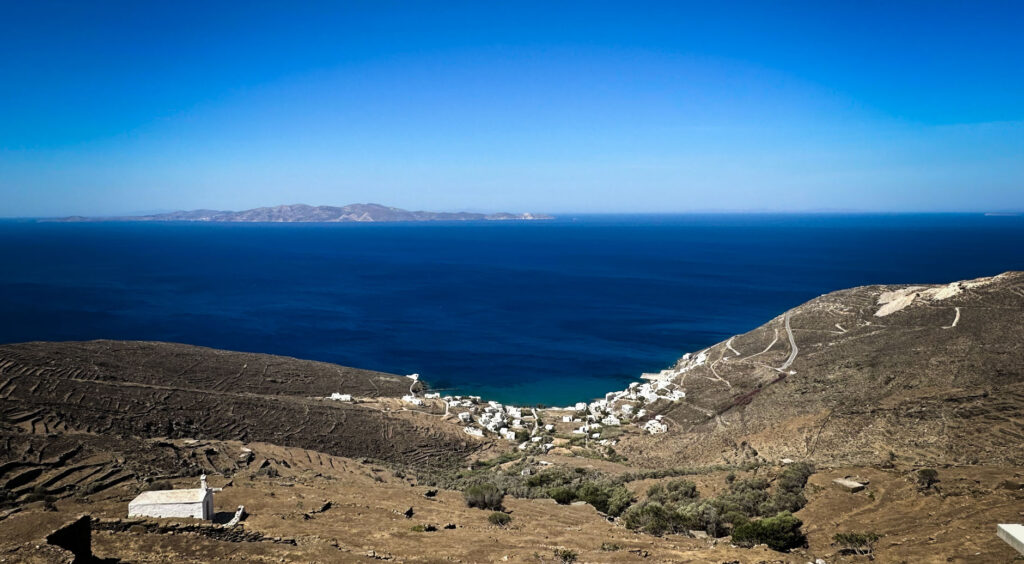
The view from Ysternia village to Ysternia bay. © Alexandra Gryparis
Bibliography
The research is based on data found among others in the books of Florakis A., 2013, “The “gyftika” of Oxo Meria Tinos forges and smithies in the 19th and 20th centuries”, Athens: Fraternity of Tinians in Athens, Karali M., 2002, ” The rural dwellings in Exomeria of Tinos”, Athens: Cultural technological foundation of тне Hellenic bank of industrial development, Collective volume, 1979, Ethnography, Athens: Peloponnesian Folklore Foundation, Florakis A., 2018, “Old quarries and marble splitters of Tinos” Athens: Piraeus Bank Group Cultural Foundation (PIOP), Collective volume, 2009 “Tetradia Exomerias” Athens: edited by Kostas Danousis, Collective volume, 2009 “Memoirs of Panormos” Athens: edited by Kostas Danousis, Collective volume, 2024 “Navigare necesse est honor to Kostas Danousis”, Athens: Fraternity of Tinians in Athens, in exhortations and directions of Dr Florakis and Mr Danousis, in other essays such as those of Iakovos Rigos but also in interviews conducted by the NWMW team in the context of the Fe26 project – “Sculpting memory”.
More info on the traces project here